
ENEMIES ASSEMBLED,
NOT PLACED
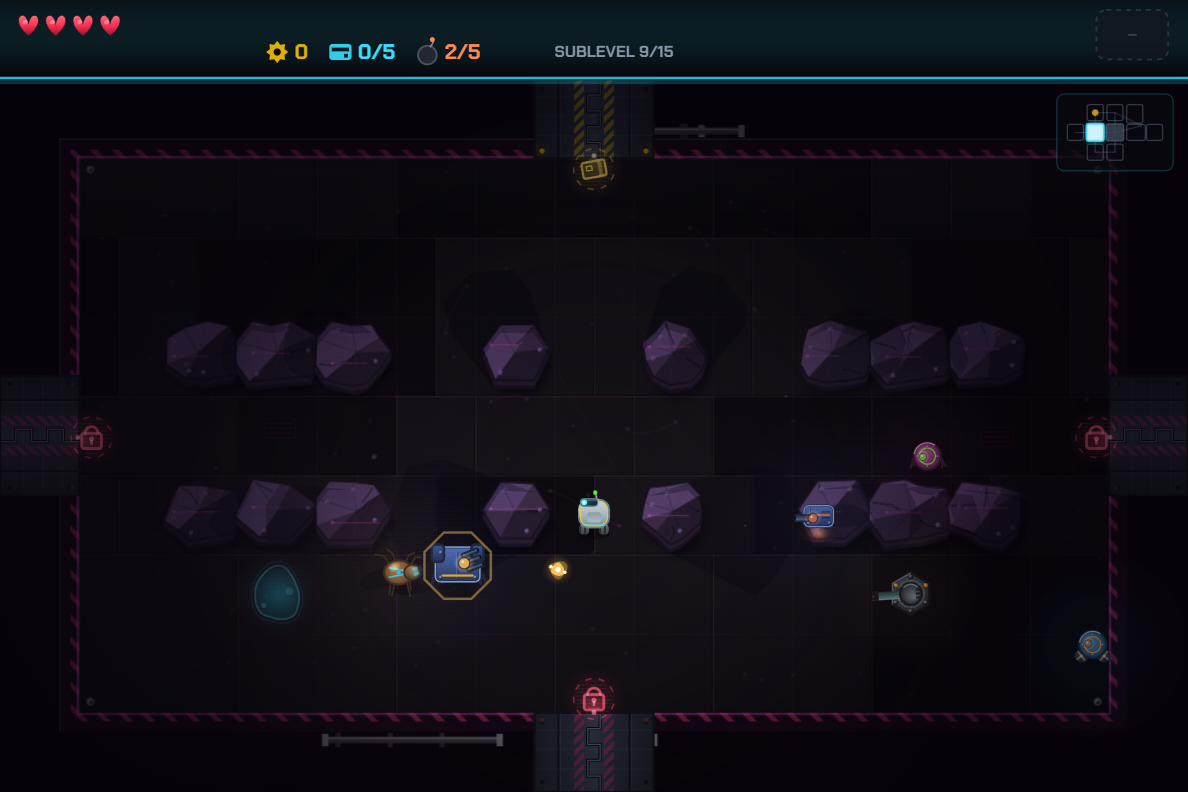
Nothing you fight in AGENTIC was placed by hand. Every robot is bought from a parts catalog on a seed — chassis, locomotion, weapon, brain, quirks — with a fully hand-authored layer mixed in on top. This log is why we run both layers, how the grammar spends its budget, and what a robot army fighting itself two hundred runs at a time keeps teaching us.
AGENTIC is a room-locked action roguelike: doors seal, robots pour in, nothing opens until everything is scrap. A game like that lives or dies on whether room 400 still surprises you — and since the premise is a machine that manufactures its own defenses, the enemies had to be manufactured too.
But pure procedure has a known failure mode: it rolls stats when you want it to roll problems. So we mix two layers on purpose. Procedural bodies supply quantity, texture, and depth scaling for free; hand-authored MECHANIC SPECIALS carry identity and counter-play, each attacking a build's assumptions — raw DPS, screen-wide fire, standing still — rather than competing on numbers. Procedural for texture, curated for the puzzle. Everything below hangs off that pillar.
THE PART GRAMMAR
Every procedural robot starts as a shopping trip: a per-room budget, spent on one chassis, one locomotion, one weapon, a brain, and zero to two quirks if there's money left. Expensive bodies crowd out expensive guns, so the budget itself does quiet balance work.
| Chassis | Hull (HP) | Touch dmg | Cost | |
|---|---|---|---|---|
| SCOUT | 4–6 | ½ heart | 2.0 | |
| DRONE | 5–8 | ½ heart | 2.4 | |
| CRAWLER | 8–12 | ½ heart | 3.0 | |
| SPIDER | 6–10 | ½ heart | 2.8 | |
| WALKER | 10–16 | ½ heart | 3.6 | |
| BRUTE | 14–20 | 1 heart | 5.0 | |
| TANK | 25–35 | 1 heart | 7.5 |
On top: locomotion (wheels fast, tracks slow, hover flies), a weapon (melee lunge, gun, spread, telegraphed laser, or a lobbed mortar — capped at one per wave, because two is a war crime), and a brain that turns the body into a behavior: strafers, snipers that need line of sight, pouncers that crouch and leap, burrowers that erupt under your feet, a tractor unit that pulls you toward it. Quirks season the roll — carried shields, splitters, death-fuse exploders, self-repair — and the part combo gets a flavored codename, so the kill log reads like a facility manifest instead of a dice table. Parts unlock by zone, so depth changes the kind of problem, not just the size of the health bar.
A BODY MUST CONFESS ITS BUILD
Procedural variety has a readability tax: nobody can memorize a bestiary of thousands of combos, so the body itself has to be the documentation.
- Size tells the truth about hull. Scale reads the HP roll within its chassis band, ±8% — and the hitbox scales with it. A body that claims to be bigger must actually be bigger, or shots that look like hits would miss.
- Guns telegraph before they commit. Projectiles cause roughly nine-tenths of all damage taken, yet guns were the one threat with no anticipatory cue. Now every gun arms a charge glow, captures its aim, then fires — cadence unchanged, because the tell borrows time from the shot's own cooldown.
- Quirks are physical props, not glowing rings. A shielded robot carries a steel barrier that narrows as charges break — the prop is the readout. Prop loudness is proportional to how much the info changes your decision: the exploder's hazard canister is the loudest thing on screen because it pays out on death; self-repair stays quiet because it announces itself.
WHEN THE DICE NEED A FLOOR
Here's the embarrassing part, because a devblog that only shows the wins is marketing. Until a recent update, the tank — our biggest, scariest chassis — had never appeared in a single procedural wave. Not rare: never. The wave builder caps any one robot's share of the budget, and that cap sat below the tank's price. A catalog part no wave could afford — and invisible in playtests, because you can't see an absence. The same cap quietly starved firepower: after a body and wheels, most cheap robots couldn't afford a gun.
Some guarantees shouldn't be left to an economy. Two composition floors now run after the budget loop, funded outside it: from sublevel 2, every wave fields one heavy (the ANCHOR — a brute, then a tank from sublevel 3), and at least three bodies that can shoot you (the RANGED FLOOR). Sublevel 1 keeps its gentler guarantee — it's the only floor a brand-new player is promised to meet.
The anchor buys a decision, not a stat. A tank in the wave forces a real fork: engage the heavy first, or clear the room around it. That's a kill-order problem, produced by the procedural layer — no new AI, no new mechanic, just a body big enough that ignoring it is a choice with a price.
THE CURATED LAYER: SPECIALS ATTACK ASSUMPTIONS
Above the grammar sits a roster of fifteen hand-authored mechanic specials (of a designed twenty-five), rolled into waves beside the procedural bodies. None is "a robot but stronger" — each invalidates a habit:
- The MIRROR SKIRMISHER cycles a reflect window — hold the trigger through its shimmer and you're dodging your own bullets.
- The DUELIST holds a visible guard; the first hit landing during it is negated and answered with a counter-lunge. Bait it with one cheap shot, then commit.
- The FUSE TWINS share one health pool, hurtable only while near each other — and their AI keeps breaking contact, turning the fight into a rhythm of burst windows.
- The WARP ANCHOR watches where you stand: camp a spot and it yanks you to it. Keep moving and it never gets to exist.
Which specials appear together is still a weighted roll — the specials are curated, the encounters are not. And several debut early as deliberately weakened teaching variants: softer stats, but telegraph timings never scale. The tell you learn on sublevel 2 is, to the frame, the tell you face at the bottom.
ROBOT WARS, TWO HUNDRED AT A TIME
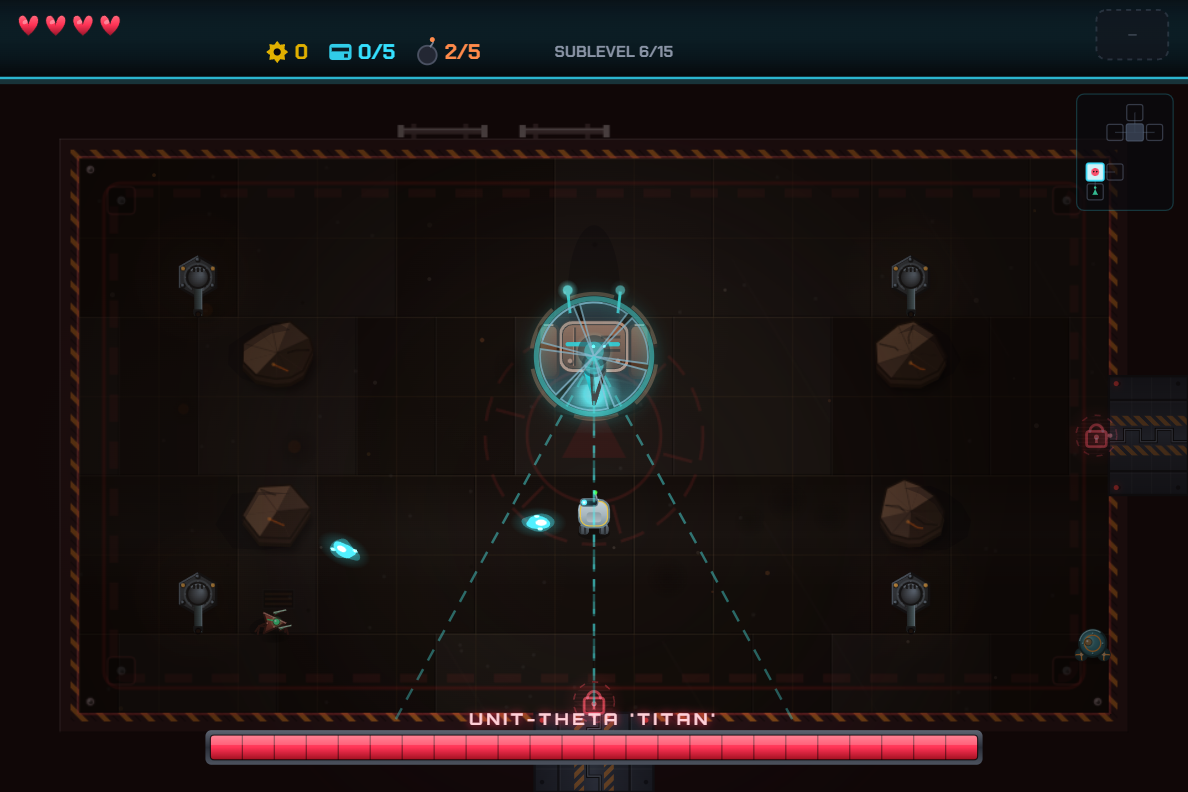
You can't balance a generator by squinting at it — its real output is a distribution. So AGENTIC has a headless harness: the actual game code running in Node, no renderer, driving a scripted bot through hundreds of seeded runs while we log damage, composition, and death causes. That's how we know projectiles cause ~90% of deaths (which bought the pre-fire tell its priority), how we caught the unreachable tank (0.0 per room at every depth), and how we proved the readability work was balance-neutral.
Then it taught us its own limits. The composition floors raised measured damage on sublevel 2 by 64% — a cliff where a ramp used to be. The bot said regression. The playtest said:
A grammar that manufactures texture, floors that guarantee the interesting problems occur, a curated roster that attacks your habits, and a standing robot war to keep it honest. The facility builds its own defenses. We just audit them.
// TRANSMISSION ENDS — LOG 001